4/9/2026

AB
What is a governed metric?
Transform your team's data discussions! Governed metrics ensure everyone speaks the same numerical language, reducing disagreements and enhancing trust in reports.
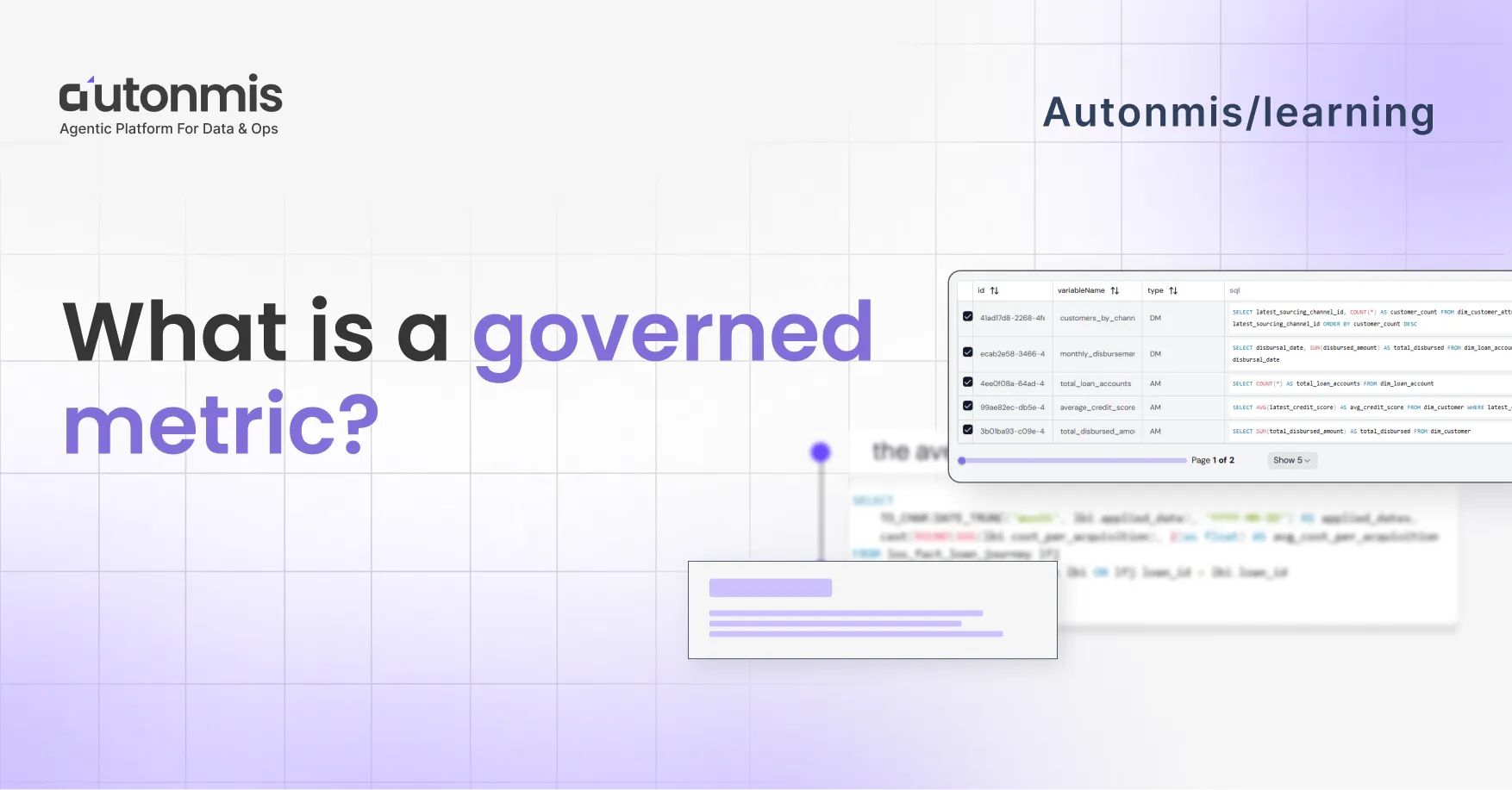
A governed metric is a business metric whose definition, calculation logic, source data, and ownership are agreed, versioned, and auditable before the number is used in a report or decision. In practice, that means the team is not guessing what “approval rate,” “conversion rate,” or “exception count” means every time someone asks. It means the number comes from a shared definition, not from whichever report or person happened to produce it that day.
Governed metrics matter because one of the most common problems in ops and data teams is that the same metric means slightly different things to different people. The docs describe this clearly: the logic behind key numbers often lives in one person’s head, reports are assembled by interpretation, and the company slowly starts trusting its own numbers less.
Why teams disagree on numbers
Most metric disagreements are not really disagreements about math. They are disagreements about definition. One report includes a filter that another report does not. One team counts a record at creation time; another counts it at approval time.
One analyst excludes old data because a column changed; another does not know that caveat exists. Over time, the metric drifts, and people stop speaking the same numerical language.
This is why meetings so often begin with “which number are we using?” Instead of discussing what to do, the room spends time reconciling reality. The underlying issue is not a lack of dashboards. It is a lack of governed definitions that everyone can stand behind.
What makes a metric governed?
A metric becomes governed when the team has made four things explicit:
- Definition - what the metric means in business terms.
- Logic - the exact formula or SQL behind it.
- Ownership - who approves and maintains it.
- Version history - what changed, when, and why.
In Autonmis’s framing, governance is not bureaucracy. It is the mechanism that makes AI outputs trustworthy enough for production. The docs say every metric goes through review before it reaches a dashboard, report, or brief, and every change becomes a new version with a visible audit trail. That is what turns a number from “probably right” into “safe to use.”

Checkout: Top 6 Ways AI Is Transforming Business Operations
What happens when metrics are not governed?
When metrics are not governed, three things usually happen.
- First, numbers start changing across reports. A leader sees one figure in a weekly deck and a different figure in Slack, and now the conversation shifts from business action to data reconciliation.
- Second, knowledge gets trapped in people. The analyst who built the logic knows why a filter exists, why a join is written a certain way, or why a number is wrong before a certain date. When that person is unavailable or leaves, the definition leaves with them.
- Third, people trust the wrong thing for too long. Reports keep arriving, so the company assumes the system is healthy. But the numbers may already be drifting, and nobody notices until a meeting, audit, or customer issue forces the truth out into the open.
What governed metrics solve
Governed metrics solve the basic trust problem.
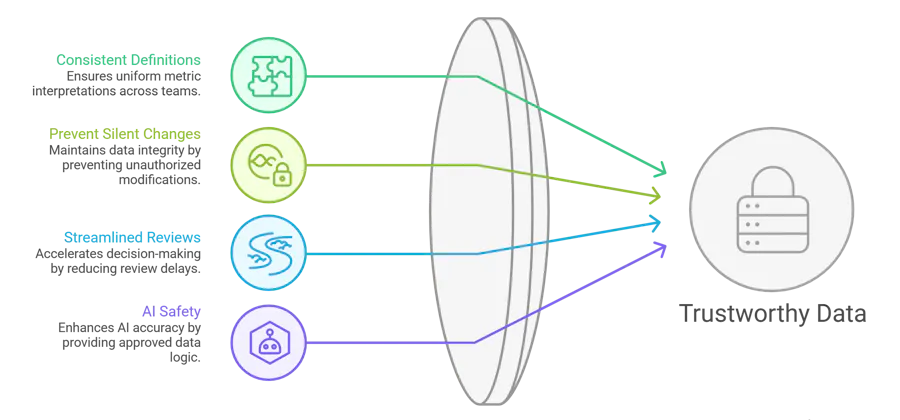
They make sure the same number means the same thing everywhere. They keep definitions from changing silently. They reduce the back-and-forth that slows down reviews. And they let leaders act on current numbers without wondering whether the data is being interpreted differently behind the scenes.
They also make AI use safer. The product docs are explicit that AI-generated SQL can look plausible while still being wrong if it uses the wrong join, filter, or business rule. A governed metric reduces that risk because the AI is not improvising definitions; it is working from approved logic stored in the Knowledge Base.
Checkout: K-Means Clustering for Anomaly Detection in Business Operations
A simple example
Imagine a company asks, “What is our approval rate this week?”
A non-governed setup might produce three answers:
- the ops report counts only completed applications,
- the finance report excludes certain channels,
- the analyst’s dashboard uses a slightly different date filter.
A governed setup removes that confusion. The company agrees in advance on what counts as an application, what counts as approved, which date field is used, which sources are trusted, and who owns the metric. Then every report, dashboard, alert, and AI-generated answer uses the same version.
What a governed metric should include
A useful governed metric usually has:
- a plain-language definition,
- a formula or SQL implementation,
- the source tables or systems it uses,
- exclusions and caveats,
- the owner or approver,
- a version history,
- and an audit trail showing how the number was produced.
That structure is what makes the metric portable. It no longer depends on memory, tribal knowledge, or one person being available to explain it again. It lives in the platform.
Why this matters for ops and leadership
For ops teams, governed metrics mean fewer surprises and less time chasing numbers. They start the day with a more current picture of the business and spend less time asking other people for status updates.
For leaders, governed metrics mean more confidence. They can walk into a review knowing the number is consistent, traceable, and based on definitions the company has already approved. That is especially important when the business is under pressure, because bad numbers at the wrong moment create expensive decisions.
For data teams, governed metrics mean less repetition. They stop answering the same question in different forms every week and spend less time re-explaining the same logic to different people. The work becomes durable instead of disposable.

Checkout: How Agentic AI Redefines Business Operations
The short version
A governed metric is not just a number on a dashboard. It is a number with a shared meaning, an approved calculation, a known owner, and a visible history. That is what makes it trustworthy enough for daily operations, leadership reviews, and AI-generated answers.
Frequently asked questions
Is a governed metric the same as a KPI?
Not exactly. A KPI is the business outcome you care about. A governed metric is the controlled, documented version of the number you use to measure it. In many companies, a KPI becomes useful only after its underlying metric is governed.
Who should own governed metrics?
Usually the owner is the team that understands the business meaning of the metric and can approve changes to it. In the Autonmis model, the definition is validated, versioned, and owned so the company is not relying on one person’s memory.
Why are governed metrics important for AI?
Because AI can generate plausible but wrong answers if the underlying definitions are unclear. Governed metrics reduce that risk by grounding outputs in approved business logic, so the answer is not just fast, it is auditable.
What is the biggest benefit of governed metrics?
Trust. Once people agree on the definition and the logic, meetings stop getting stuck on “which number is right” and can move to “what do we do next.”
Recommended Learning Articles
5/30/2026
AB
Why the Same Metric Looks Different Every Time
2/6/2026
AB
K-Means Clustering for Anomaly Detection in Business Operations
Actionable Operations Excellence
Autonmis helps modern teams own their entire operations and data workflow — fast, simple, and cost-effective.