Table of Contents
How Agentic AI Redefines Business Operations
March 1, 2026

AB
Here is a situation a lot of operations leaders know well.
Your team is handling a loan disbursement process. The files come in, they move through the system, and somewhere in the middle — a document gets stuck. Maybe a bureau check failed silently. Maybe an API timed out. Nobody knows. The ops team finds out two days later when a customer calls to ask why their loan hasn't come through.
You pull the data, piece together what happened, and fix it. Then the same thing happens three weeks later with a different file. Or a NACH mandate failure that nobody caught until the morning. Or KYC applications piling up in a queue that no one was watching.
The data existed throughout all of this. The problem is that nobody was watching it in real time — and even when someone was, they were watching dashboards that showed what had already happened, not what was about to go wrong.
This is where agentic AI comes in. Not as a buzzword, not as the next thing your vendor is selling, but as a genuinely different approach to how operations can work.
What Does 'Agentic AI' Actually Mean?
Most explanations of agentic AI start with definitions and architecture diagrams. Let's skip that.
The simplest way to understand it: traditional AI tools — dashboards, reports, even most BI platforms — wait for a human to ask a question. Agentic AI doesn't wait. It monitors situations continuously, recognizes when something needs attention, and either acts on it or surfaces it to the right person immediately.
Think of it as the difference between having a report sent to you every morning and having a team member who's watching the system at all times, knows what normal looks like, and taps you on the shoulder the moment something breaks pattern.
Traditional AI answers questions. Agentic AI watches for problems — and in some cases, handles them.
In practical terms, an agentic AI system can: connect to your live data sources, understand what 'normal' looks like for a given operation, detect exceptions as they happen, route the right alert to the right person, and in more advanced setups, trigger a corrective workflow automatically.
It is not a chatbot. It is not a fancier dashboard. It is something that sits between your data and your operations and keeps things from falling through the cracks.
Why Traditional Tools Left Operations Behind
Over the last two decades, businesses invested heavily in two things: systems to run operations (ERPs, LMS, CRMs) and tools to understand them (BI platforms, data warehouses, analytics dashboards). Both categories had their purpose. Both had a major blind spot.
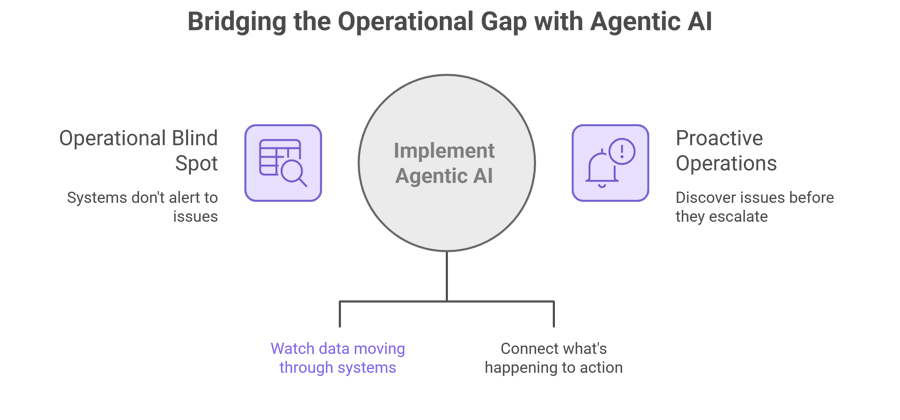
The systems that run operations are good at processing transactions. They don't tell you when something is quietly going wrong. An ERP knows a file is stuck. It doesn't know to tell you.
The tools that analyze operations are good at showing you history. They give you last month's data in a well-designed chart. By the time that chart is in front of you, the problem it's describing is two weeks old.
There's a gap between knowing something happened and being able to do something about it in time. For years, that gap was filled by people — ops managers who checked logs, senior staff who'd seen the same patterns enough times to recognize trouble early, escalation chains that eventually got information to whoever needed to act.
That gap is expensive. It shows up as delayed disbursements, missed SLA windows, exceptions that turned into complaints, compliance lapses that nobody caught before audit time.
48 hours
Average time between when an operational failure occurs and when an ops team discovers it — usually through an escalation, not a system alert
Agentic AI addresses this gap directly. It doesn't replace the systems you have. It sits on top of them, watches the data flowing through them, and bridges the distance between what's happening and what needs to be done about it.
What Actually Changes When AI Becomes Agentic in Operations
There are four specific shifts that are worth understanding clearly, because they're where the real change happens.
From reporting to monitoring
A dashboard shows you a snapshot. An agentic system watches continuously. The difference sounds small but the implications are significant. When you're watching continuously, you can catch a disbursement file that's been sitting for four hours. When you're looking at a daily report, you catch it the next morning — if the report even surfaces it.
This shift from periodic reporting to real-time monitoring is probably the most important thing agentic AI changes in operations. It moves the fundamental question from 'what happened?' to 'what's happening right now?'
From aggregate data to specific exceptions
Most analytics tools are built around aggregates — total volume, average processing time, overall SLA compliance rate. These numbers are useful for understanding trends. They're not useful for fixing today's problem.
Agentic AI works at the level of individual transactions and events. It doesn't just know that your KYC completion rate is 74%. It knows which specific applications have been stuck for more than 48 hours, why they're stuck, and who needs to be notified. That's the difference between insight and action.
From data team workflows to ops team workflows
In most organizations today, getting an answer from data requires going through someone technical. An ops manager who wants to know how many NACH mandates failed last week has to wait for a data analyst to pull it, or learn SQL, or build the report themselves in a BI tool.
Agentic AI, done well, puts operational intelligence directly in the hands of the people running operations. An ops head should be able to ask a question about their process in plain language and get a real answer — not submit a ticket and wait two days.
From reactive to proactive
This is the one everyone talks about, but it's worth being specific about what it means in practice. Reactive ops means your team is always a step behind — they're responding to failures that have already happened. Proactive ops means the system catches patterns early enough that you can intervene before the failure.
A mandate failure rate that's been climbing for three days is a signal. An agentic system can surface that signal before it becomes a collections problem. A KYC queue that normally clears in 24 hours but is now at 72 hours is a signal. Catching it early means you can fix the bottleneck before it becomes a regulatory conversation.
Where Operations Teams Feel This Most
Agentic AI is relevant across industries, but the impact is sharpest in operations-heavy businesses — particularly financial services, lending, and any operation built around high-volume, time-sensitive transactions where exceptions have real costs.
Here are four areas where the change is most concrete.
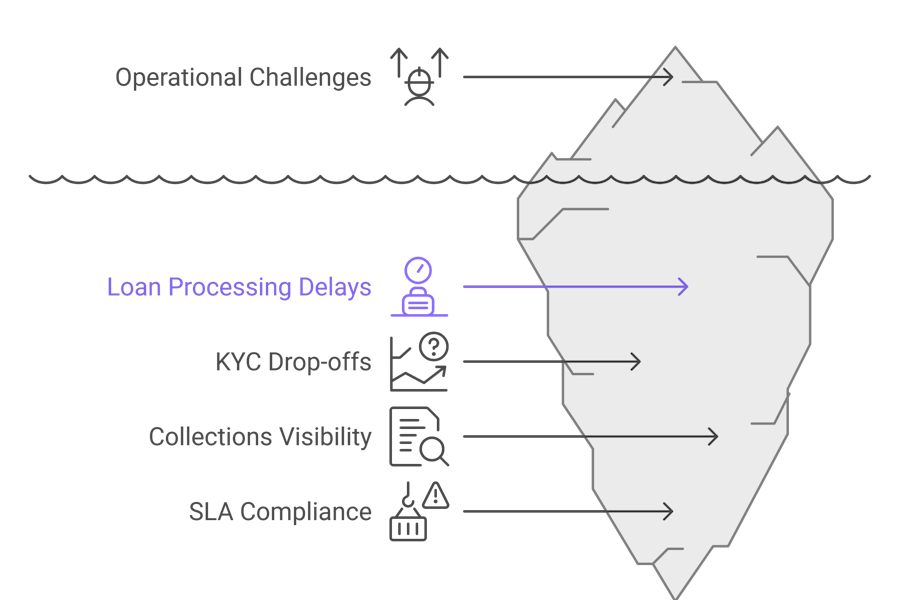
Loan disbursements and processing pipelines
A stuck disbursement file costs money. Every hour it sits unprocessed is a delay for the customer and potential revenue leakage for the business. In a high-volume NBFC or bank, dozens of files might get stuck in a day — API failures, incomplete documentation, manual review queues that nobody checked.
An agentic system connected to your loan origination system knows what a normal processing time looks like. It flags files that fall outside that window, tells you exactly where in the process they're stuck, and routes the notification to the right person without anyone having to run a query.
KYC and onboarding funnels
KYC drop-offs are both a revenue problem and a compliance risk. Applications that start the process and don't complete it represent customers you're losing — but they also represent incomplete records that can surface during audits.
With agentic monitoring on a KYC pipeline, you can see in real time where applications are falling off, which step is causing the most friction, and how long specific applications have been sitting at each stage. That level of visibility makes it possible to intervene early — reassign stuck cases, identify systemic issues before they compound.
Collections and mandate management
The first 30 days after a payment is missed is the window that matters most in collections. Most teams don't have clean visibility into that window because their data lives across three systems — the loan origination system, the repayment platform, and wherever customer contact history is stored.
Agentic AI can stitch those sources together and give collections teams a live view of their portfolio — which mandates are failing, which accounts are aging, which agents have capacity, what the patterns look like this week versus last. That kind of operational intelligence makes the difference between a team that's constantly catching up and one that's actually in control.
SLA compliance and exception governance
Most operations have SLAs — internal turnaround time commitments, regulatory timelines, customer-facing service standards. Most operations also have no reliable way to know, in real time, how they're tracking against those SLAs.
Agentic monitoring means SLA breaches get flagged before they happen, not after. A process that's at 80% of its allowed window gets a warning. A process that's breached gets an alert and an owner. The audit trail is automatic.
The Gap Agentic AI Is Actually Closing
It's worth naming this clearly because a lot of the conversation around AI in operations focuses on automation — the idea that AI will do tasks that humans currently do. That's real, but it's not the most important thing happening.
The more important thing is this: most businesses have accumulated enormous amounts of operational data that they are not using well. Not because the data isn't there. Not because the analytics tools aren't capable. But because there is no system that connects the data to the decision in time for the decision to matter.
By the time an ops manager sees a report, the decision window has often passed. By the time a data team builds a dashboard, the process it's measuring has already generated three months of problems. By the time an escalation reaches the right person, it's already a fire.
The problem isn't lack of data. It's the distance between data and action.
Agentic AI shortens that distance. It connects operational data to operational decisions in real time, with enough context that the person receiving the signal knows what it means and what to do about it.
This is what makes the category genuinely different from what came before — not AI that helps you understand your operations after the fact, but AI that helps you manage them as they're happening.
What to Get Right Before You Start
There's a real risk of buying into the idea of agentic AI without setting it up to actually work. Here are the things that matter before anything else.
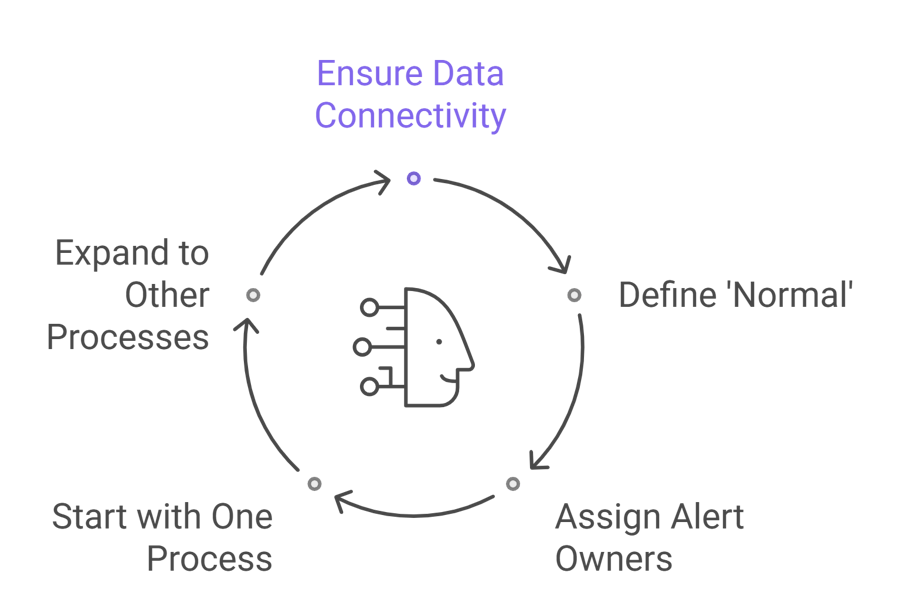
- Your data needs to be connectable. Agentic AI is only as good as its access to live operational data. If your core data is spread across systems that can't be connected or is only available as weekly CSV exports, the real-time monitoring piece doesn't work. Getting clean data pipelines in place is a prerequisite, not an afterthought.
- You need to define what 'normal' looks like. Agentic systems detect anomalies. To do that, they need to know what normal is. That means defining your SLAs, your expected processing times, your acceptable exception rates — in numbers, not in general terms.
- Alerts need owners. An alert that goes nowhere is noise. For agentic monitoring to actually change how operations work, each type of exception needs a clear owner — the right person who has the ability to act on it. This is an organizational question as much as a technology question.
- Start with one process. The temptation is to instrument everything at once. The better approach is to pick one critical process — the one where failures are most expensive or most frequent — get it working well, and then expand. The learning from the first implementation makes everything after it faster.
The Bigger Picture
Agentic AI is not going to replace operations teams. If anything, it makes ops teams more important — because it frees them from the reactive, firefighting mode that consumes most of their time and gives them the bandwidth to actually manage their operations strategically.
The organizations that figure this out first are going to have a meaningful advantage. Not because they have fancier technology, but because their operations will be genuinely more reliable — fewer failures slipping through, faster response when things do go wrong, clearer accountability, better data to make decisions with.
The businesses that don't figure it out will keep running the same playbook: dashboards that describe the past, escalation chains that discover problems late, teams that are always a step behind.
The gap between those two kinds of operations is going to widen. The good news is that the tools to close it are available and becoming more practical every month.
Frequently Asked Questions
What is agentic AI in simple terms?
Agentic AI refers to AI systems that don't wait for a human to ask them a question. They monitor data continuously, recognize patterns and anomalies, and either act or alert the right person without needing to be prompted. In an operations context, this means the system watches your processes in real time and flags problems as they happen, not after the fact.
How is agentic AI different from regular AI or automation?
Traditional automation handles specific, predefined tasks — it does the same thing in the same way every time. Regular AI generates responses or predictions when you ask for them. Agentic AI combines these: it can perceive what's happening across a system, make decisions about what matters, and take action or trigger a response. It operates with more independence and handles more complexity than rule-based automation.
What business operations benefit most from agentic AI?
Operations with high transaction volumes, time-sensitive SLAs, and multiple data sources that need to be monitored simultaneously benefit most. In financial services, this includes loan processing, KYC and onboarding, collections, mandate management, and compliance tracking. Any operation where exceptions have real financial or regulatory consequences is a strong candidate.
How do you get started with agentic AI in operations?
Start with a single critical process where failures are expensive and data is accessible. Define what 'normal' looks like numerically, establish who owns each type of exception, and set up monitoring with clear alert routing. Once one process is working well — meaning fewer surprises, faster response, clearer accountability — apply the same approach to the next one. The infrastructure you build for the first process makes all the subsequent ones faster.
What data infrastructure do you need for agentic AI to work?
You need data pipelines that can pull from your operational systems in near real time, your LOS, LMS, CRM, payment processor, and wherever else critical transactions are logged. Batch data or end-of-day exports limit what's possible. The closer to live the data, the more useful the monitoring. Clean, normalized data also matters, the AI needs to be able to compare current state against historical patterns reliably.
About Autonmis
Autonmis is an agentic platform built for actionable data and ops control, helping data and operations teams move from reactive firefighting to real-time intelligence. If you're dealing with the problems described in this article, it's worth a conversation.
Recommended Blogs
5/4/2026
Abhranshu
The Data to Decision Gap: What It Costs and Why It Exists
4/16/2026
AB
How to Preserve Institutional Knowledge in Data Workflows
Actionable Operations Excellence
Autonmis helps modern teams own their entire operations and data workflow — fast, simple, and cost-effective.